
Three quotations for the same metal component can appear comparable until one assumes a different material, another omits finishing, and a third prices dimensions that have not been checked against the site. The apparent price difference may reflect an undefined scope rather than a more efficient fabrication method. A useful request for quotation describes the intended use, current drawings, quantities, interfaces, approval stages and the work expected from the fabricator. This guide helps project engineers, architects and procurement teams assemble that brief for a single bracket or a repeated assembly. It is a purchasing and coordination guide, not a substitute for approved engineering design.
Define the item and its function
Begin with a sentence that says what the part does and where it goes. Is it an equipment bracket, enclosure, frame, architectural panel or group of connected pieces? State whether it is visible to occupants, concealed in a service area, or connected to an existing structure. The outline alone cannot establish loads, appearance requirements, access for maintenance or responsibility for the supporting structure. Where structural performance or safety is involved, ask the responsible engineer to provide and approve the design requirements rather than asking a workshop to infer them from a photograph.
Define the supply boundary as carefully as the part: cutting only, cutting and bending, welding and assembly, finishing, packing, delivery, or site installation. FLEZCO's custom metal fabrication page describes sheet and section work, frames, brackets, enclosures, assemblies and coordinated finishing or installation within an agreed scope. That range does not mean every step is automatically included in every offer. Ask each supplier to list included work, exclusions and separate approvals.
Issue drawings that can be used to price the work
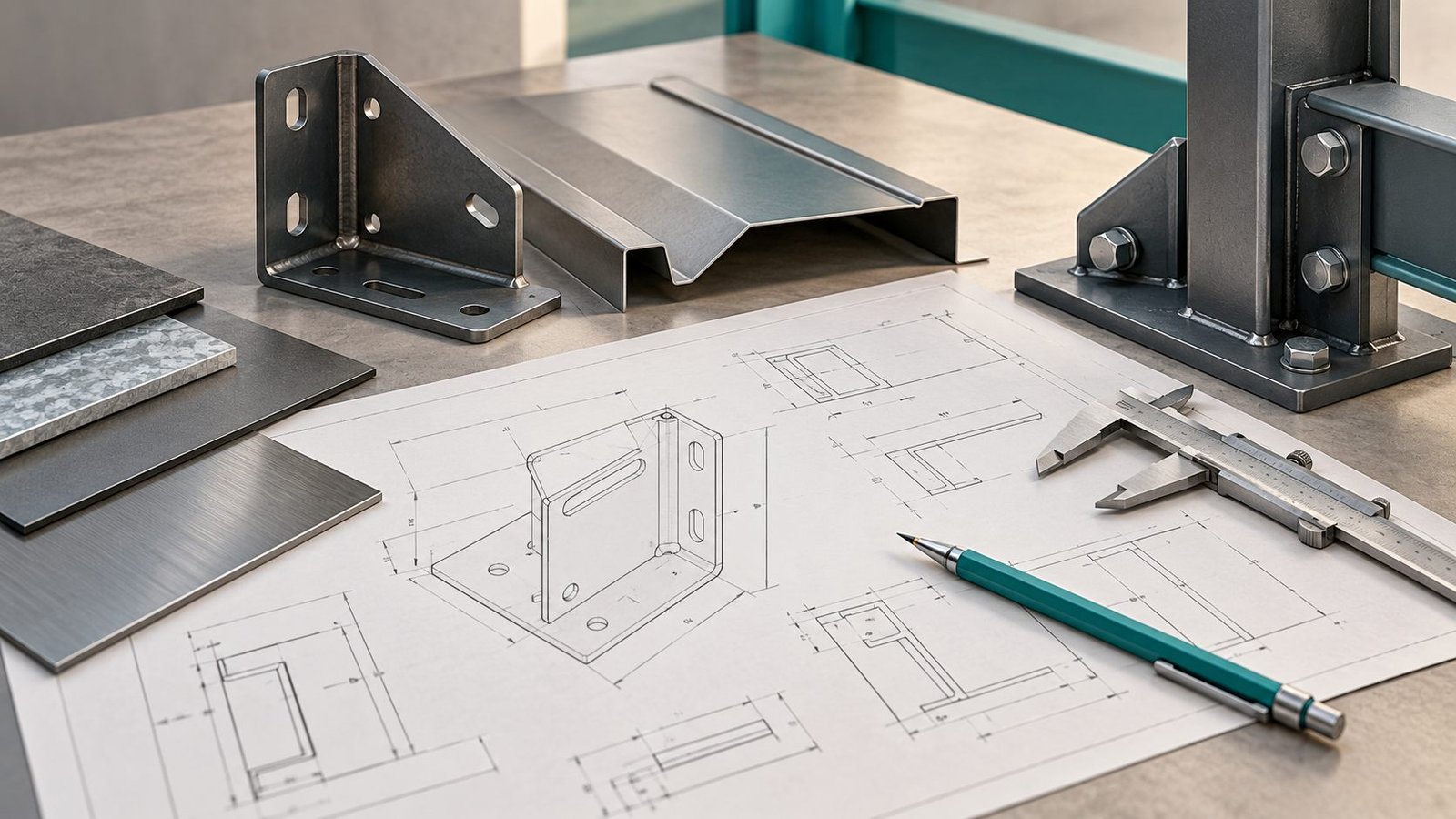
Send a drawing with a clear revision identifier and status, such as preliminary for quotation or approved for fabrication. Show dimensions, views, sections and details where needed, including units, hole locations, folds, openings and connection points. If the part sits within an assembly, add an arrangement view showing its orientation and neighbouring items. An attractive perspective view does not resolve a concealed joint or a cladding interface. When no final drawing exists, say so and ask suppliers to identify the survey and drawing work needed before a firm fabrication price.
Photographs and a three-dimensional model can explain design intent, but they do not replace controlled dimensions and approvals. If two files contain different versions of a detail, state which revision governs. Identify who reviews shop drawings, approves a first piece, and authorizes changes. The AISC Code of Standard Practice addresses documents, approvals and tolerances for its structural-steel scope. It is a useful illustration of why responsibilities must be explicit; it is not automatically the governing standard for every decorative part or Saudi project.
Specify material instead of saying only steel
State the material type, required grade or specification, sheet thickness or section size, and whether substitutes are allowed. “Good steel” is not a testable procurement description, and a reference image cannot prove a material grade. If the design fixes a particular material, attach its approved specification. Ask suppliers to identify alternatives separately and obtain the designer's approval before changing it. If the material has not yet been selected, describe the use and environment and request options for specialist review rather than treating an initial suggestion as a final design decision.
Separate the material of the main piece from that of fixings and accessories. Say which faces remain exposed and which will be concealed. Material and surface decisions affect cutting, joining, finishing and transport protection. A specification copied from an unrelated project can be misleading even when the shapes look similar. Describe actual conditions, such as indoor or outdoor use and exposure to cleaning or weather, so the project team can decide what is relevant.
Identify the dimensions that control fit
Not every dimension has the same consequence. Call out the spacing of equipment fixing holes, the clearance for a door to open, an edge that meets cladding, or a surface that bears against concrete. Ask the designer to specify acceptable tolerance and measurement method for each critical interface. A general instruction to “make it exact” is not a practical acceptance criterion. AISC's fabrication-tolerance guidance discusses how structural steel tolerances interact with foundations and adjacent systems. Apply the coordination principle, not an assumed universal number.
Provide any available site measurements and identify what must be checked before fabrication starts. For an existing base plate, wall, machine or purchased item, send the latest interface drawing and its approval status. Site conditions may require an adjustment strategy, but the design team should determine it. Ask who owns the site survey and how a mismatch between the site and contract drawing will be resolved. This question can prevent a factory-made component from arriving at an interface that was never verified.
Describe connections and finish
Show joints and assembly method in the project documents, whether they involve welding, mechanical fasteners or both. “Weld well” should not stand in for a designed connection. Where joint performance matters, the type, size, location and inspection requirements belong in approved documents. The American Welding Society's welding-symbol standard explains the role of symbols in conveying joining and examination information on drawings. Use the standard specified for the project, with design and acceptance responsibilities assigned to qualified parties.
State the finish or performance objective, surfaces to be treated, accepted colour and texture, and treatment of visible edges or weld marks. If powder coating is requested, clarify whether it belongs within fabrication or is quoted separately. Ask for the surface preparation, coating system and colour approval rather than only the word “powder”. FLEZCO's powder-coating page is a useful related service page. A coating name alone does not establish a particular service life or resistance level; those depend on the specified system and conditions of use.
Break down quantities and delivery
List quantities by part number and revision. Distinguish a one-off prototype, a trial batch and repeated production. Parts that look similar may differ at a connection or opening, so avoid combining them under a single vague line item. If quantities could change, ask how the price and programme would respond. State the delivery destination, unloading constraints, packaging needs and whether installation or site lifting is within the supplier's scope.
A final delivery date is difficult to judge without the dates for drawing approval, material confirmation and any sample review. Describe milestones that can be checked: information received, questions resolved, shop drawings approved, material and finish accepted, first piece reviewed where appropriate, then production and delivery. Invite the supplier to disclose assumptions at each stage. Do not carry a production duration from a different project into this request as a promise.
Decide whether a first-piece review is useful
A sample or first-piece review can be valuable for repeated visible parts, assemblies with sensitive interfaces, or a finish where appearance is an acceptance point. State who supplies it and what will be reviewed: critical dimensions, hole pattern, assembly fit, surface appearance or matching to a reference component. Approval of one sample does not replace design approval or inspection of the remaining production. Record the review result and the route for resolving observations before the rest of the batch is released.
If the request begins with an existing part to be copied, explain whether it is a controlled, undamaged reference or an altered item from site. Reproducing it without review may reproduce an old error. Where reverse engineering or functional verification is needed, identify that as separate work rather than assuming a visual measurement is sufficient.
Compare like with like
Use one comparison sheet for every quotation: material and grade, drawing revision, quantity, cutting and bending, welding and assembly, finishing, sample review, inspection, packing, transport and installation. Record exclusions and unresolved questions beside the price. A low offer may omit delivery or finish protection, while a high offer may include an engineering or survey task that others have ignored. Price alone cannot prove quality. Ask for evidence proportionate to the item's function and the project's approved requirements.
Distinguish laser cutting from a complete fabricated assembly. Cutting creates shaped parts from sheet; an assembly may also require forming, joining, fitting and finishing. A cutting file by itself may yield a quotation for loose profiles rather than the finished item. Request separate prices for additional processes when that makes the options easier to compare.
A practical send-ready checklist
Attach the current drawings and revision list, part schedule and quantities, material and finish requirements, existing interface measurements and photos, delivery location, installation boundary, requested programme and approval stages, and a named technical contact. Mark missing facts explicitly. Ask the bidder to return assumptions, alternatives and exclusions with price and lead time instead of leaving them buried in a later email thread.
Send the package through FLEZCO's quotation route and review the custom fabrication page for the offered scope. Handle confidential project drawings through a channel accepted by your organization. The checklist aims to reduce avoidable scope differences and unanswered questions; it cannot guarantee a final price or delivery date before the project information is verified.