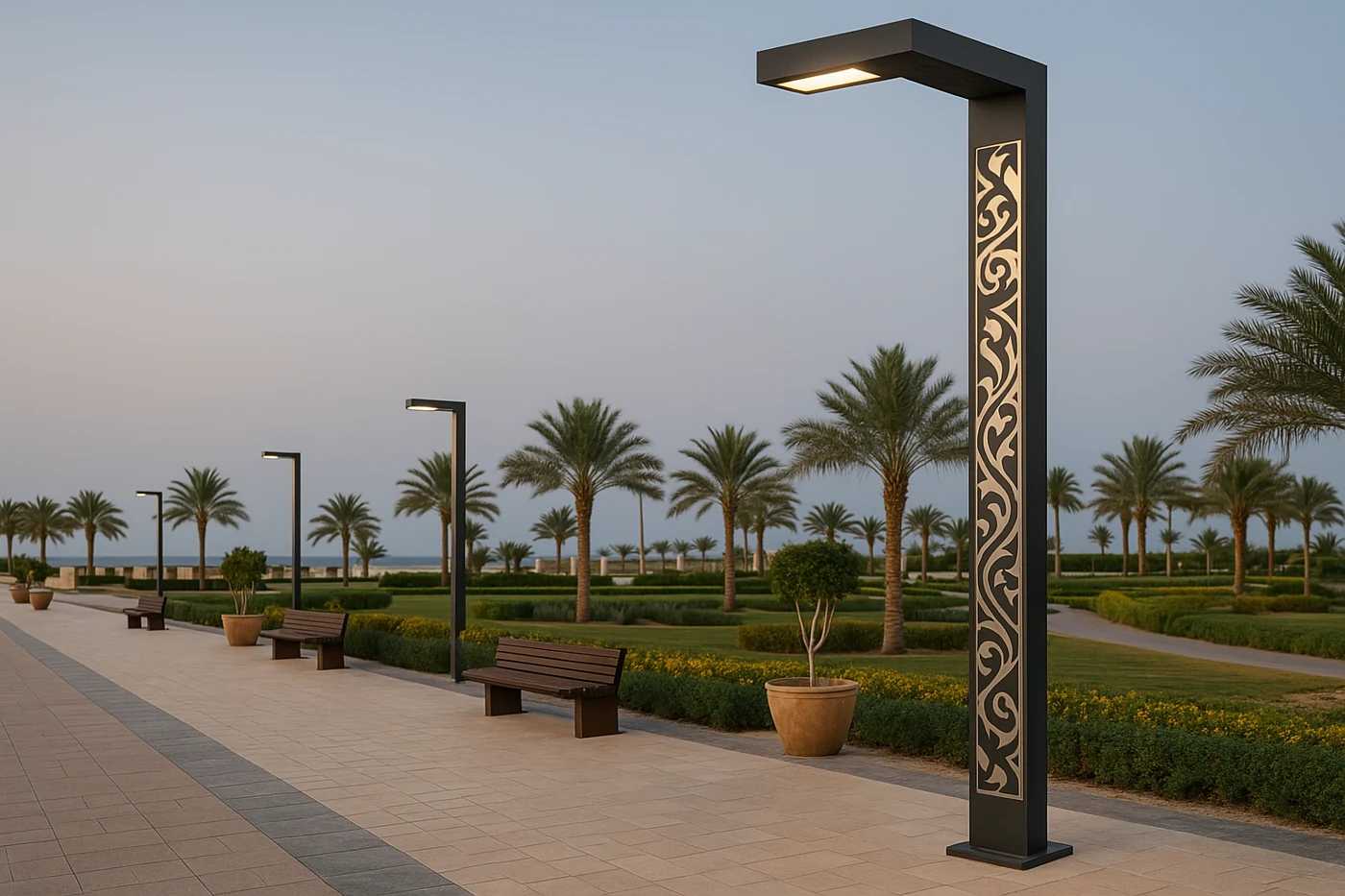

A reference photograph can explain the appearance of a decorative lighting pole, yet leave several suppliers pricing different packages. One offer may include only fabricated metalwork; another may include luminaires, anchors and installation. Before comparing totals, a buyer needs a common description of the intended product and the responsibilities around it. This guide helps owners, landscape architects, contractors and procurement teams prepare that description. It is a quotation checklist, not a lighting design, structural calculation, electrical installation procedure or statement that one detail suits every Saudi project.
Start with the place and the purpose
Describe the actual setting: a landscaped walkway, hotel courtyard, commercial plaza or another defined area. State whether the proposal is a new installation, an extension or a replacement alongside existing poles. Include a location plan and recent site photographs. Explain what the poles should look like from the main approaches, how the space is used, and which neighbouring elements need coordination. A sample photograph should be identified as a visual reference, not silently treated as a dimensioned construction drawing.
The FLEZCO decorative lighting pole page describes metal fabrication for landscaped areas, pedestrian routes and commercial developments, with custom brackets and mounting arrangements. It also makes the boundary between the pole, electrical equipment and foundations part of the agreed scope. Use that distinction when preparing the enquiry. Do not assume that a product image confirms the material, hidden construction, electrical performance or installation details for your particular site.
Turn the design reference into a pole schedule
Give each pole type a stable reference, such as a drawing mark used consistently on the layout and quantity schedule. For each type, record the proposed overall height, visible profile, arm arrangement, decorative pattern, luminaire mounting and finish. Mark dimensions as preliminary or approved. If a feature has not been decided, name it as an open item rather than leaving bidders to make different assumptions. Separate the number of poles from the number of arms, luminaires or decorative panels.
Include drawing revisions and identify who can approve changes. A site can contain several visually similar poles with different mounting interfaces or access requirements. A type-by-type schedule makes these differences visible. Ask each bidder to return the same schedule, identifying offered details, deviations and missing information. Keep an alternative design separate from the base offer so a lower price cannot conceal a changed height, omitted component or different decorative treatment.
Coordinate the luminaire before fixing the metalwork
State whether the luminaire has been selected and provide its manufacturer's current information where available. Identify its mounting connection, orientation, dimensions and weight, together with any information the responsible designer needs to assess the assembled arrangement. Clarify whether brackets, adapters, decorative shrouds and associated fixings belong to the pole package or another supplier's package. Ask who confirms compatibility and who approves any change after the metalwork has entered production.
The light fitting and the supporting pole answer different questions. A preferred pole silhouette cannot establish the lighting result of a space. The appointed lighting designer should determine the required performance and review the proposed equipment. If the luminaire remains undecided, ask for an explicitly qualified proposal and record the interface still to be resolved. Avoid treating a photograph, a stated wattage or a decorative shape as a completed lighting assessment.
Assign design and foundation responsibilities
Identify the party responsible for the pole's structural design, the foundation design and coordination of the connection between them. Supply the approved design basis and any project specifications already available. State whether soil information, site levels and foundation drawings exist, and who will obtain missing information. A fabrication enquiry should not invite the workshop to adopt dimensions from an unrelated project simply because the visible pole looks similar.
Ask who supplies anchor components, templates, base details and the records required before manufacture. Distinguish new foundations from a proposal to reuse existing ones. Where existing anchors or bases are involved, identify the required site verification and the designer who can accept the proposed arrangement. This guide supplies no universal foundation depth, bolt size, wind rating or structural section. Those decisions depend on the approved project information and the responsible engineer's assessment.
Coordinate access, cables and site interfaces
A useful package identifies cable entry and maintenance access requirements without pretending that these constitute a complete electrical design. Ask the electrical designer and installer to confirm their requirements before fabrication details are frozen. Record who provides electrical equipment, internal components, protective arrangements, cabling, testing and energisation. Do not place an unapproved opening or extra fitting on a drawing merely because it appears convenient for one trade.
Mark interfaces with paving, landscaping, drainage and nearby services. Explain the intended finished ground level and how any exposed base treatment relates to the architectural finish. In occupied areas, identify access restrictions and the party responsible for coordinating work. The purpose is to get the right questions to the appointed specialists early; it is not to instruct a buyer to open electrical equipment, alter protective systems or perform live electrical work.
Describe the finish beyond a colour name
Provide the colour reference, desired appearance and relevant project finish specification. Explain whether the poles are intended for an exposed coastal setting, an inland landscaped site, sheltered areas or other known conditions. Ask the responsible designer and finishing supplier to confirm the proposed preparation and coating system, its suitability for the specified metalwork, and the acceptance information required. A colour match alone does not describe the complete finishing scope.
Clarify how decorative inserts, joints, access covers and site touch-ups are handled. Agree a sample or first-item review when appropriate, and identify who accepts the appearance. The powder-coating specification guide explains how to organise a finishing enquiry. It does not make powder coating the automatic choice for every pole. Require the offer to name its proposed system and exclusions rather than promising a universal service life or warranty that has not been agreed.
Make maintenance part of the purchasing discussion
Ask how the owner will identify and obtain the parts that may need attention later. The enquiry can request a parts list, access information, finish-care instructions and the applicable equipment documentation. Clarify which items can be replaced separately and which changes would require specialist review. Name the team that will receive handover records so it can comment on access and record requirements before the order is placed.
The FHWA lighting-selection guidance includes site coordination and maintenance access among general design considerations. It is cited here for that planning principle only. It is historical United States guidance, not evidence of Saudi approval, a governing standard for this project or a FLEZCO certification. Your appointed team must establish the applicable local and contractual requirements.
Compare offers using a responsibility matrix
Give every bidder the same headings: design and detailing, fabricated pole, arms and brackets, decorative components, finish, luminaires, foundation interfaces, electrical scope, packing, delivery, unloading, installation and handover. Ask for an included, excluded or by-others response to each heading. Record who owns the interface whenever adjacent activities are supplied by different parties. An attractive unit price is not comparable if another bidder has priced a broader package.
Keep quantities, drawing revisions and provisional items visible in the commercial comparison. Ask how approved changes will be reflected in price and programme. Record delivery assumptions and the information needed before a date can be confirmed; do not turn a generic article into a lead-time promise. Review payment, taxes, warranty wording and contractual obligations in the actual offer and contract. A checklist can organise that review but cannot invent the terms on either party's behalf.
Agree review points and handover evidence
Identify the submittals expected before production: coordinated drawings, the type schedule, luminaire interface confirmation, finish information and any specified samples. Name the reviewer and the acceptance basis from the project documents. Decide how revisions will be controlled after review. A request to approve an appearance sample should not be confused with approval of structural or electrical design; those responsibilities need their own explicit allocation.
At handover, agree the required identification, drawings, finish records, equipment information and installation or test records for the contracted package. Ask how outstanding items will be recorded and who closes them. If installation is by another contractor, specify what the fabricator supplies to support that handover. Do not assume that a delivered pole proves that the full lighting system has been installed, tested or accepted for operation.
Send a quotation package that can be answered
Collect the site plan, pole schedule, reference images, current drawings, luminaire information, finish requirements, known foundation interfaces and a responsibility matrix. Add quantities, delivery location, access constraints and the review contacts. State what is preliminary and which decisions are still pending. Ask the supplier to return written assumptions and a list of information still required before the scope can be fixed.
A concise enquiry can then begin a useful technical discussion rather than a sequence of incomparable prices. Start with the lighting pole product page, or send the package through FLEZCO's quotation page. Share sensitive drawings through a channel approved by your organisation. The aim is a clear, reviewable scope for your actual project, with architectural appearance, manufacturing information and specialist responsibilities aligned before commitment.